Midway Atoll -- Diving the Darwin Point
Geological History of Midway Before we go diving, let's take a look at the fascinating geological history of this atoll; it helps explain the unique fish fauna of the region. Midway was born over 27 million years ago as a submarine volcano over the Hawaiian Hotspot, a volcanic plume deep in the earth's mantle. This stationary hotspot is still active today about 1,400 miles east southeast of Midway's present location, approximately under the Big Island of Hawaii. It was and is the birthing place of all Hawaiian islands.
Midway's reefs could probably keep growing upward indefinitely over the sinking island but for one thing: the moving Pacific Plate is carrying them inch by inch out of the tropics. As warmth and sunlight decrease, the corals and coralline algae that form the reefs grow more slowly. They become less and less able to compensate for the sinking volcano beneath. Soon, geologically speaking, Midway Atoll will disappear.
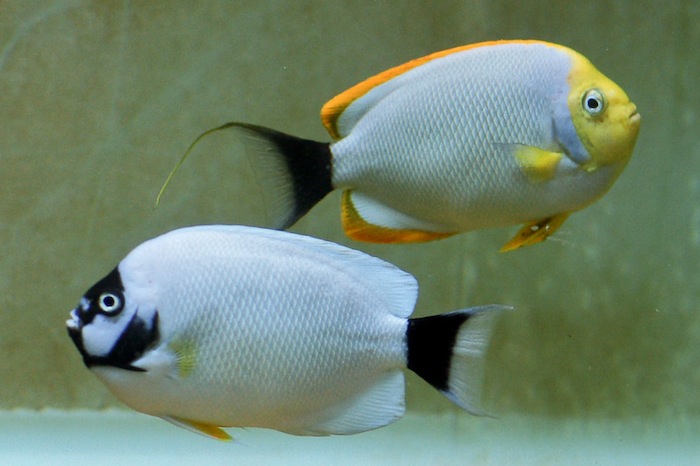
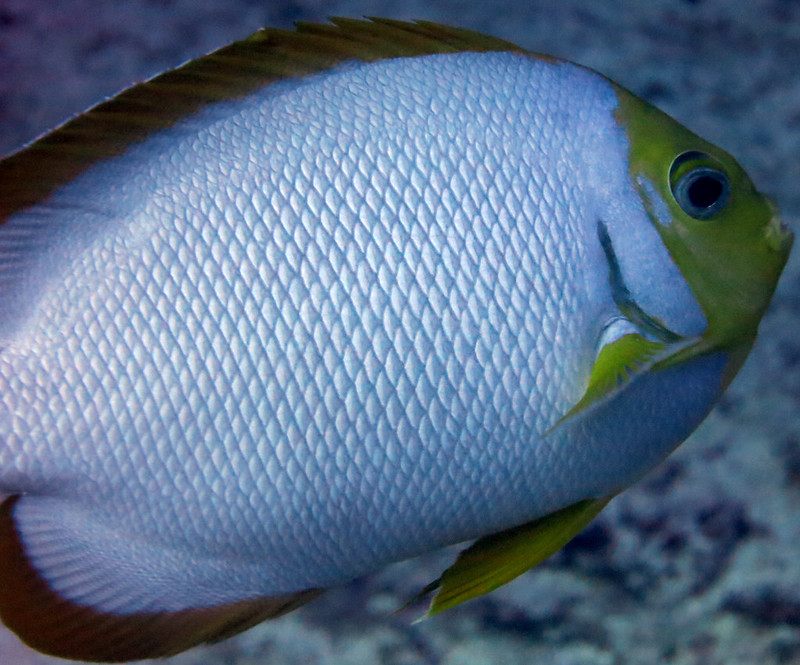
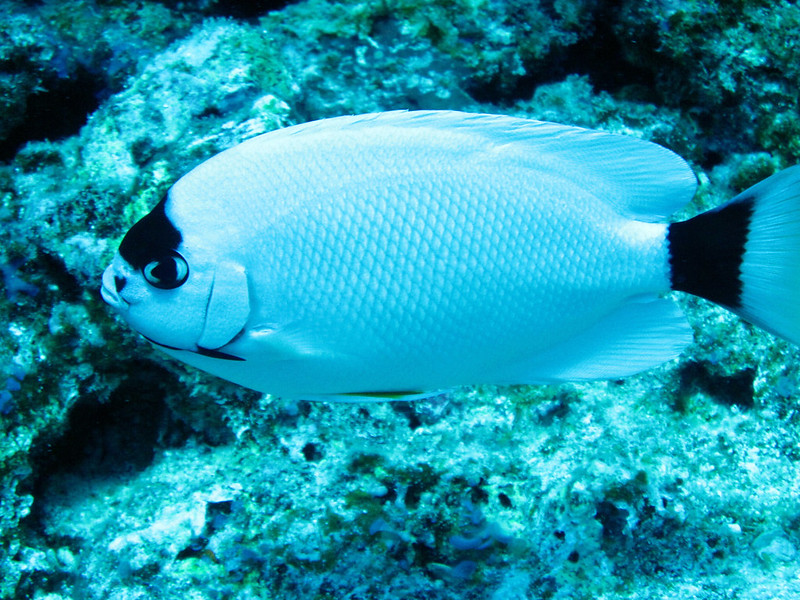
Diving the Darwin Point What is it like to dive the Darwin Point? I first found out in 1992 as part of a small scientific expedition to Midway jointly sponsored by the Waikiki Aquarium and the Bernice Pauahi Bishop Museum. The Bishop Museum needed photographs and specimens of various fishes, while the Waikiki Aquarium sought live animals for display -- specifically the masked angelfish (Genicanthus personotus). Not discovered until 1972, masked angelfish are among the rarest and most beautiful endemic Hawaiian fishes. They are almost never seen around the main Hawaiian Islands but are common at Midway. Travel to Midway in those days was not easy to arrange. Permits were required from both the U.S. Navy and the U.S. Fish and Wildlife Service and special permission was required to dive outside the lagoon. (Today, by contrast, Midway is a national wildlife refuge open to the public.) On the morning of May 28, 1992 four of us met at O`ahu's Hickam Air Force Base for the weekly military flight. John Earle and Therese Hayes represented the Bishop Museum, Marj Awai the Waikiki Aquarium, and I was "dive buddy at large" with a camera. The flight (strapped into sling seats on a windowless C-41 cargo plane) lasted a little over two hours.
The following day we planned to take a boat outside the lagoon to an 80-foot site that on previous collecting trips had yielded plenty of masked angelfishes. Marj and Therese wanted to catch at least half a dozen early on to allow ample time for their swim-bladders to decompress and their stomachs to empty. (Fishes transported with food in their systems soon foul their own shipping water.) The plan was to attach a float-line to the bottom, then tie the angelfish off at about 40 feet to decompress overnight. The next morning we would move them up to about 15 feet, and in the afternoon bring them to the surface.
Our dive site the next morning was a ledge well offshore that paralleled the south side of the atoll at a depth of about 80 feet. Several communications cables traversing the ledge served as location references and, incidentally, made good tie points for our float lines. (During the war, undersea cables, perhaps these very ones, enabled Midway and Navy headquarters on Oahu to communicate secretely without fear of radio interception by the Japanese fleet.) John Earle and I made a reconnaissance dive and had no trouble finding Masked Angelfish. Unlike most members of their family, these snow white beauties swim in the open well off the bottom, feeding on plankton. Females have a jet black mask and saffron pelvic fins. Males, less abundant, sport a saffron mask and long tail streamers. We looked specifically for juveniles or sub-adults; large adults adjust less easily to captivity and their longer spines are more likely to pierce the plastic bags in which they are shipped. Incidentally, small masked angelfish are always female. This species lives in social units consisting of about three to four females and a male. The only way to become male is up through the ranks -- mature as a female, then change sex. It is believed that only the largest, most dominant female in a group undergoes this transformation. Fishes with this socio/sexual life history (and there are many) are known as "haremic protogynous hermaphrodites."
As we recorded and photographed reef fish, Galapagos Sharks and large Amberjacks swung by to investigate. Big, blue-green, spectacled parrotfishes (Chlorurus perspicillatus) crunched serenely on the substrate, oblivious of our presence. In the main Hawaiian Islands, these endemic parrotfishes are mostly speared out; here they were abundant. Indeed, the Midway fishes were unusually tame, even curious, swimming over and surrounding us whenever we remained still. We all remarked on this phenomenon later; perhaps the fish thought we were seals. Tying a line to the cable, we surfaced and told Marj and Therese they would find juvenile and sub-adult masked angels right below. While they gathered their nets and cages and headed down, John and I stripped off our wetsuits and warmed gratefully in the sun. Why, I asked, are masked angelfish common at Midway but rare around the main Hawaiian Islands? The full explanation, said John, involves plate tectonics, geology and climatology as well as biology. The short answer is simply that the water is cooler. Masked angelfish and a number of other endemic Hawaiian species seem to prefer the lower temperatures found in the northwest islands. Around the main islands these temperatures occur only at depths exceeding about 200 feet. In a half hour, Marj and Therese were back, chattering with cold but radiating success. Each had caught both masked and Japanese angelfishes, had tied them off at 40 feet as planned, and were now looking forward to some good hot curry at the mess hall.
One of the most interesting biological phenomena associated with remote islands is endemism: the emergence of unique species of plants and animals. The Galapagos Islands were made famous in this regard by Charles Darwin, but even richer are the Hawaiian Islands with an estimated endemism rate of about 90 percent for terrestrial plants and animals; 24 percent for fishes. It was quickly becoming obvious that the concentration of endemic fishes at Midway was even higher than 24 percent, partly because many of the warm-water Indo-Pacific species common in the main Hawaiian Islands had dropped out of the fauna, but also because the endemics were simply more abundant up here. Of the common fishes I was seeing, easily fifty percent were species unique to the Hawaiian chain: 4 out of 5 angelfishes, 3 out of 5 parrotfishes, 12 out of 27 wrasses, 5 out of 8 damselfishes, and 4 out of 12 scorpionfishes.
For the next several days Marj and Therese looked for more small angelfishes, moving the captured ones up the line and then over to the lagoon. In the lagoon, they hung the cages off the normally unused cargo pier where it would be easy to check on them as well as to retrieve and pack the fishes on the morning of our flight home. During this time, we tried diving some different spots. The most memorable for me was an extensive area (at about 40 feet) where the bottom consisted of a great jumbled mass of jagged limestone formations. Around these caves, arches and trenches, I saw my first Hawaiian black grouper (Epinephelus quernus), another deepwater endemic never encountered by divers around the main islands.
The day after Marj and Therese had hung their precious angelfishes in cages off the cargo pier we returned from our dive to a disturbing sight-a great, dirty gray South Korean destroyer tied closely alongside. A stream of rusty-looking effluent poured from a hole in its side exactly where the delicate, snow white angelfishes lay suspended in their cages. Inquiries revealed that the normal fueling pier was out of order, the destroyer (on maneuvers nearby) had been directed here, and the cargo pier was temporarily off limits to us. Marj and Therese were distraught, but there was nothing to be done. It was too late in the trip to catch, decompress and empty the stomachs of more specimens. Glumness prevailed at dinner, but joy at breakfast; an early morning check found the destroyer gone and the angelfishes no worse for the experience. Our last dive was in the blue-green lagoon. Here, for the first time, we encountered patch reefs of mostly living coral. (Outside the lagoon the bottom is eroded limestone, largely barren.) Dominated by Porites compressa, a low branching species endemic to Hawaii, the lagoon reefs were home to schools of convict tangs, yellow tangs and endemic spectacled parrotfish. Was it my imagination, or were the surgeonfishes larger here than at home? Later, I found out that size records for several species have been made at Midway. Paradoxically, although these tropical fishes are at the extreme northern limit of their range the cooler water promotes growth. Convict tangs, for example, which range from East Africa to Panama, grow larger at Midway than anywhere else--attaining over ten inches (26 cm). John Earle and I stayed down well over an hour on the shallow lagoon reefs. Just about the time we were due in, a blunt-nosed, 7-8 foot tiger shark circled the boat causing Marj and Therese some consternation -- not for themselves but for us. The visibility was poor and we might have blundered into it. Luckily, the shark wandered away a few minutes before we came up. It was early in the season for tiger sharks. In late summer, they enter the lagoon in numbers to gorge on fledgling albatross chicks that fall in the water while learning to fly. It had been a great trip. Marj and Therese had captured eight, small masked angels and two Japanese angels, the maximum allowed by their permits. They packed them in oxygenated double plastic bags with layers of insulating newspaper between and placed them in sturdy cardboard boxes for the trip home. Meanwhile, I had learned a great deal about Hawaiian endemism, seen lots of rare fishes, and exposed as much film as I could. The mood was festive the next morning as everyone who was anyone, from the base commander to the Sri Lankan police chief, turned out for the event of the week -- the arrival of the plane from Honolulu. As the big C-41 pulled up, I wondered if there would be reporters onboard. Today was June 4, the anniversary of the famous battle, the day on which fifty years ago, many young Midway-based pilots and a great many Japanese sailors gave their lives for their respective countries. I had expected a ceremony, a speech, perhaps a gun salute-but there were no reporters and nothing had been planned. Mail was handed out as usual, a few crates of vegetables were unloaded, and soon boarding was announced. We walked slowly out over the concrete. The albatrosses and their ugly chicks next to the runway didn't even look up as we climbed aboard the nearly empty cargo plane for the two-hour flight home. I was sad to leave. The birds had quite fascinated me and the diving was wonderful. I doubted I would ever be back to this out-of-the-way place; happily I was wrong. Five years later... Now fast-forward to 1997: budget cuts have forced the Navy to pull out and the U.S. Fish and Wildlife Service now controls the atoll-the nation's newest wildlife refuge. To keep the airport open as an emergency mid-Pacific landing site, the Navy contracts with the Phoenix Corporation of Atlanta to maintain the island's infrastructure. Then someone has a brilliant idea: use this infrastructure for revenue-producing tourism. This Pacific atoll has amazing birds, superb diving, great sports fishing and considerable historical interest. And it's a short 2 1/2 hour flight from Honolulu. The old Bachelor Officers' Quarters are renovated into comfortable hotel rooms. Hydroponic vegetable gardens are put in. A classy French restaurant materializes on the beach overlooking the turquoise lagoon, complete with a French husband-and-wife culinary team. A divemaster is hired for the new fully equipped dive shop. The scene is set for my return, this time as a tourist accompanied by Marcia, my wife. Our evening flight to Midway was on a comfortable Aloha Airlines Boeing 737 out of Honolulu International Airport. (During nesting season flights are in the evening to minimize disturbance to the birds.) Onboard we ran into an old diving friend, Linda Bail, and her 14-year-old daughter Shawna. Linda, it turns out, was flying to Midway to assist underwater photographer David Doubilet. David was on the island now. The aircraft carrier Yorktown, downed during the Battle of Midway, had just been located at 17,000 feet by Robert Ballard and a National Geographic crew. Things were hopping!
Midway was much as I remembered it, although most of the old barracks and abandoned buildings -- the school and church had been torn down. I did not miss them as the newly-liberated space was occupied by birds. The mess hall still had its complement of foreign workers, and still served fiery hot curries. Most folks still got around by bicycle, but golf carts had been brought in and cell phones were ubiquitous. The Bachelor Officers Quarters (now the hotel) looked much the same, although improved with more comfortable furniture. The only truly new buildings were the Clipper House restaurant overlooking the lagoon (featuring fresh croissants for breakfast and fresh fish and lobster every evening) and the Midway Dive & Snorkel and Midway Sport Fishing shops.
The tiny wreck (only the wings and cockpit remained, lying upside down) was also home to unusual invertebrates. On the sand and rubble bottom nearby was a new species of sea cucumber, probably endemic. A small branching coral close to it was completely unfamiliar to me. In a wing compartment filled with empty tun shells I found Dardanus brachyops, a large anemone-bearing hermit crab previously known only as bycatch from deepwater lobster traps. I had long wanted to photograph one alive. The hermit crab had obviously been raiding an octopus's lair for a new home. Luckily for it, the octopus was nowhere in sight. On our last dive the Corsair bestowed one final treat: a magnificent, 8-foot, tiger shark swept in to investigate us as we hung on the anchor line for our safety stop. After a couple of passes it disappeared into the blue. Of course, I was out of film.
With its rarely seen deepwater endemics, unusual semitropicals, big marine animals, and millions of birds, the Darwin Point did not displease. In days to come, when fish-watchers keep life lists as birders do today, I predict Midway Atoll National Wildlife Refuge will be booked far in advance. And who knows what surprises might be found at other remote Darwin point locations around the globe. Henderson and Ducie Atolls, anyone?
References:
For more information see:
|