Last Updated on February 10, 2023 by Matt
Cowries are known for their amazing shiny, silky shells that can fetch absurd prices from collectors.
Cowry is the common name given to the marine gastropod mollusks found in the superfamily Cypraeoidea, of the order Littorinimorpha. There are five families in the Cypraeoidea superfamily; the Cypraeidae, Eratoidae, Ovulidae, Triviidae, and the Velutinidae. The true Cowries, and what are most commonly referred to as Cowries, are the family Cypraeidae.
Hawaiian Cowries are members of the Cypraeidae cowry family, and are absolutely stunning in their shells patterning and live body coloration.
Unlike “normal” mollusks, like snails you will find in the garden, the mantle of cowries almost completely encompasses the shell. This almost strange design is what creates the beautiful shells that are typical of the cowries.
Typical mollusks secrete their shells from the inside-out, as they live within their protective shells. This is the reason that the outside of the shells is weathered while the inside is very shiny. In cowries however, the shells are secreted from the outside-in; the newest shell growth is therefore on the outside which creates the unique shiny and glossy appearance.
Having the mantle covering the shell protects the shell and enables it to remain polished and glossy, protecting it from the weathering effects of the ocean.
The diet of cowries, Hawaiian Cowries included, is poorly known, as they normally hide during the day and feed at night. However it is thought that sponges are the primary prey of cowries.
While the smooth shell and narrow toothed aperture of cowries makes them hard to break open, they still have a wide range of predators, such as octopus, crabs, and cone shells. Cowry shells are often used as lures for octopus fishing!
In this article we will run through the ten Hawaiian Cowry species most likely seen. There are some that are endemic to Hawaiian waters, and others that have a wider range.
IN THIS ARTICLE
Leviathan Cowry
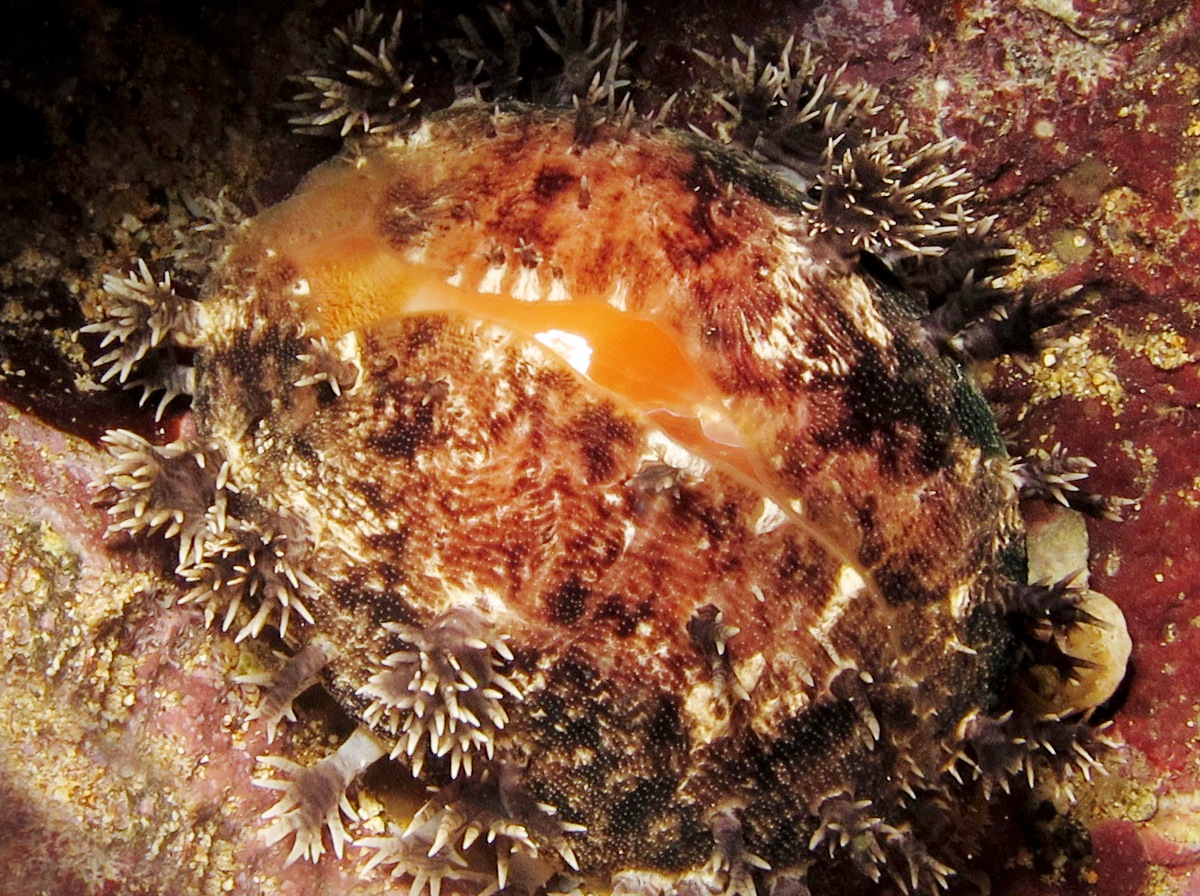
The Leviathan Cowry, Lyncina leviathan, is a large species of cowry, with three subspecies; one endemic to the Hawaiian Islands, one found throughout Polynesia, and one found throughout the central Pacific and Indian Ocean.
The shell of the Leviathan Cowry is a creamy brown color, marked with transverse darker reddish brown bands. Undersides of the cylindrical shells are whitish to pale brown, with a long wide aperture with many teeth. In living Leviathan Cowries the mantle has a brown, white, and grey mottled coloration, getting almost transparent. They have external antennae and sensorial tree-shaped papillae.
The shape of the papillae is best used to identify this species, as they are large and tufted.
Leviathan Cowries have a minimum shell size of 0.87 inches (22 mm) and a maximum of 3.9 inches (98 mm), but with an average size of 2.4 inches (60 mm) in length.
They inhabit caves and crevices on the coral reef, found usually around 30 feet or less deep.
Gaskoin’s Cowry
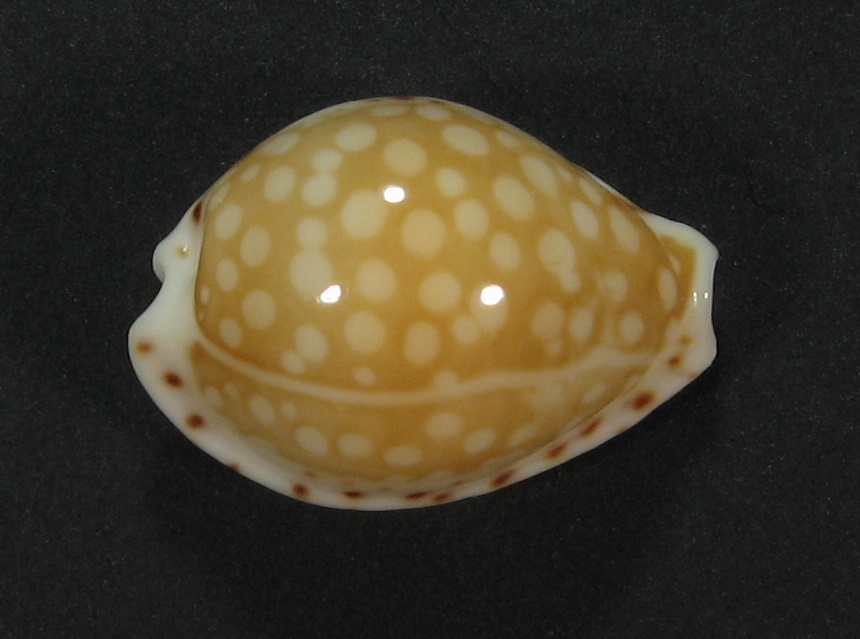
Photo Credit: Wikipedidier, CC BY-SA 4.0, via Wikimedia Commons
The Gaskoin’s Cowry, Cribrarula gaskoini, is a small and magnificent cowry which is found in the islands of both Hawaii and Fiji. The shell size varies between 0.4 – 1.2 inches (10 – 30 mm) in length.
The shell is a lovely orange hue, and has numerous pale spots of varying sizes across it. There is a white band running around the base of the shell which has dark spots.
In the living Gaskoin’s Cowry the mantle and foot are both bright red. In a fascinating modification, there is a flap of skin at the end of the foot which can be detached to 3enable the cowry to get away from predators.
The Gaskoin’s Cowry occurs from shallow habitats to depths of around 100 feet, and are found under ledges, in crevices, and on cliffs. During the day they hide in rubble away from predators, and emerge at night where they feed almost exclusively on a species of red sponge.
Mole Cowry
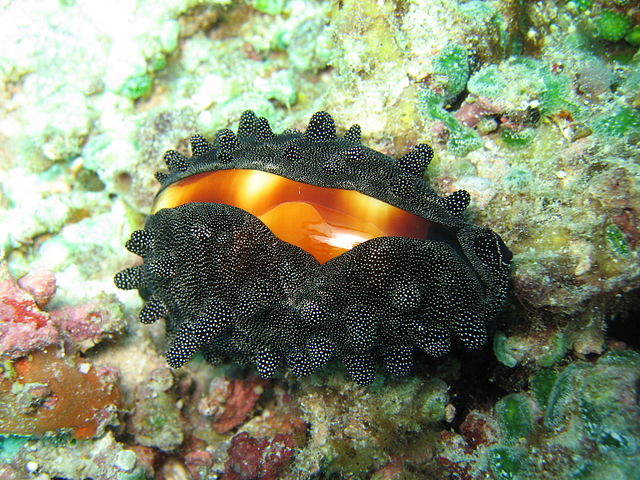
Photo Credit: Juuyoh TANAKA, CC BY 2.0, via Wikimedia Commons
The Mole Cowry, Talparia talpa, is found throughout the Indo-Pacific region and whilst reasonably rare in Hawaiian waters, they do grow to their largest size in these waters. They grow to a maximum size of 4.1 inches (105 mm) in length, but average 2.0-2.8 inches (50-70 mm).
The shell of the Mole Cowry is brown and banded with gold, with black or dark brown around the base and on the underside. The mantle is a deep black color, densely covered with minute green spots and studded with broad, wart-like papillae.
It is found both in sheltered waters and along exposed coastlines, normally at depths of at least 20 feet.
Tiger Cowry
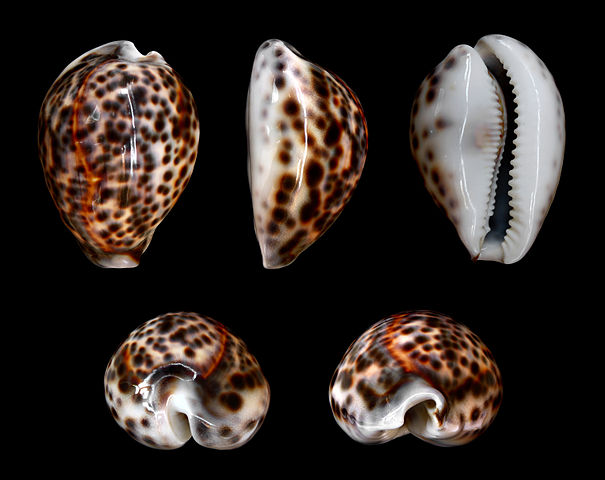
Photo Credit: By H. Zell, CC BY-SA 3.0,
The Tiger Cowry, Cypraea tigris, is common throughout the Indo-Pacific region, but is found, like the Mole Cowry, at its largest size in the waters of the Hawaiian Islands. They can measure up to 6 inches (15 cm) in length.
Tiger Cowries are so called due to the coloration of the shell. The shell has a white or very pale blue-white base coloration, and is covered with dark brown or black circular spots, which can have a hazy look. These spots can vary in color greatly between individuals, and it is said that the pattern is unique to each individual. The base is white, and the aperture has many teeth. Often there is a blurred red line which runs the length of the shell. The mantle is mottled dark gray with long, pointed, white-tipped papillae. As with other members of the Cypraea genus, the shell is remarkably polished looking.
Found mainly between depths of 35-130 feet, the Tiger Cowry is often associated with live coral colonies, such as Acropora, either found on the reefs themselves or the sandy substrate nearby.
It is more likely to be seen during the day than some other species of cowry, probably due to the fact they are too large to hide! Unfortunately they were once common, but have decreased in number greatly due to shell collection.
Granulated Cowry
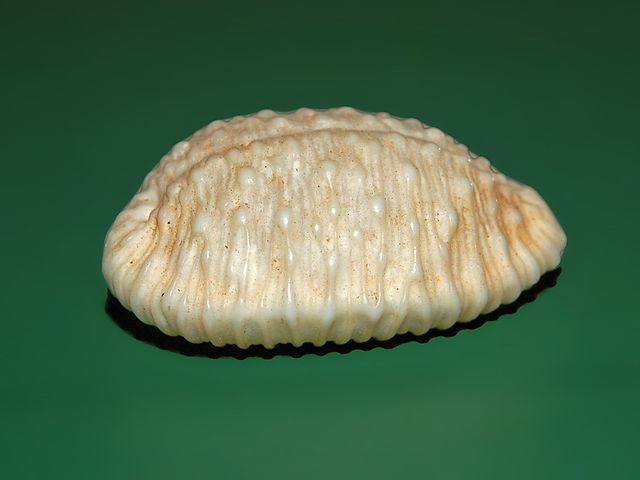
Photo Credit: Hectonichus, CC BY-SA 3.0
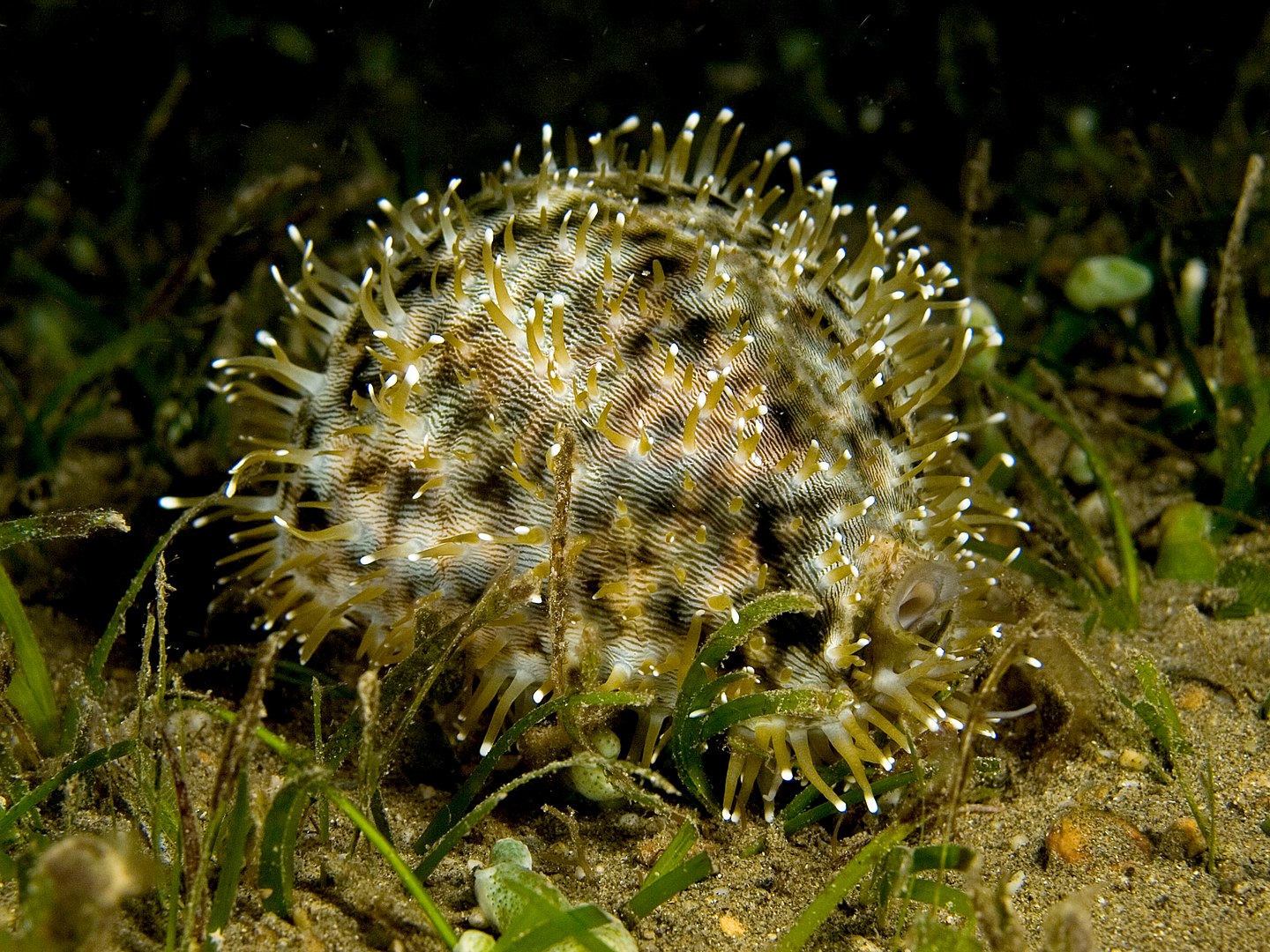
The Granulated Cowry, Nucleolaria granulata, is endemic to the Hawaiian and Marquesas Islands. It is quite an unusual cowry, but has an exceptionally beautiful shell. It is slightly flattened, and is a wide oval shape. The shell is pinkish-brown in coloration, and has many nodules, often interconnected with thin ribs. The underside of the shell is white and has many deep, stunning looking grooves.
It isn’t just the shell that is brilliant either; the live animal has many papillae which are so long it almost resembles a sea urchin or ball of algae. The mantle is pinkish or reddish in color.
The Granulated Cowry is found at depths of between 16-82 feet hiding in crevices, caves, and under rocks, emerging at night to feed on sponges, algae, and coral polyps. They reach a maximum size of 1.9 inches (49 mm) and average 0.87-1.1 inches (22-28 mm).
Groove-Tooth Cowry
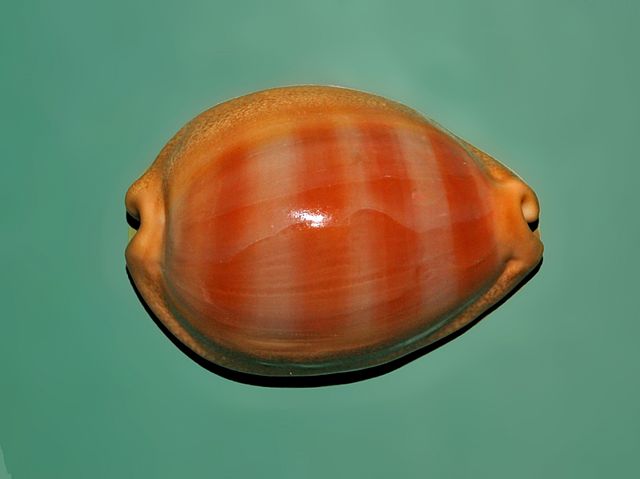
Photo Credit: Hectonichus, CC BY-SA 3.0
The Groove-Tooth Cowry, Lyncina sulcidentata, is another endemic Hawaiian cowry, and perhaps the most abundant. The shell is very rounded in appearance, and has four fairly indistinct red-brown bands on a lighter blue-grey background. At the base of the shell the sides are finely marbled and are a creamy brown to deep purple color. Light tan coloration is found on the underside of the shell. The name is derived from the unusually deep grooves between the teeth that extend partly across the base.
The live cowry is very pretty; the mantle is a tan color crossed with many dark brown fine longitudinal lines. Papillae are broad, flat, and white in color, and have many branches. The foot of the cowry is a much lighter color, white to light tan, while the tentacles are a dark grey.
Found under ledges and in small coral caves from the shallows to around 90 feet deep during daylight, they emerge at dusk to feed. They average 1.1-1.4 inches (27-35 mm) in length, but can reach a maximum size of 3 inches.
Reticulated Cowry
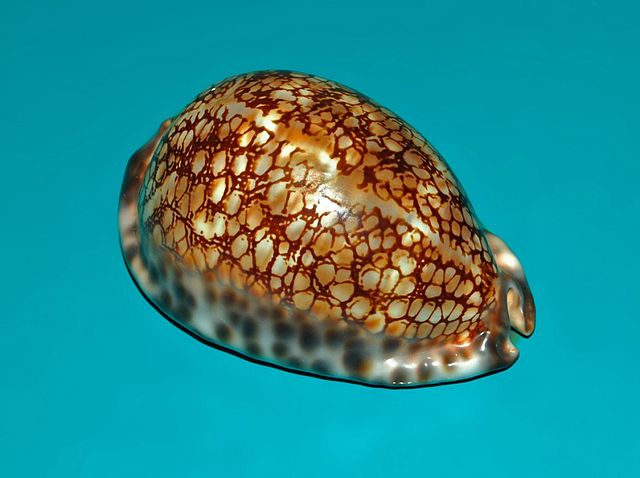
Photo Credit: Hectonichus, CC BY-SA 3.0
The Reticulated Cowry, Mauritia maculifera, is found throughout the Indo-Pacific region, and there have been four subspecies found. They have absolutely stunning shells; the base coloration is dark brown, and is spotted with many irregularly sized white spots that it creates an almost net-like effect. At the base of the shell the sides are white with hazy dark spots.
In the live Reticulated Cowry, the mantle is transparent and is covered with quite fine and pointed papillae which have a blue-white coloration. This aids in camouflage and gives the mollusk a hazy and fizzy appearance. The foot is a dark grey color.
Fairly common in Hawaiian waters, it is found in shallow waters, and also in subtidal and low intertidal waters. It is usually found under rocks or hiding within coral reefs at a minimum depth of about 13 feet, to around 50 feet. They hide during the day and emerge at dusk to feed on sponges or coral polyps.
Checkered Cowry
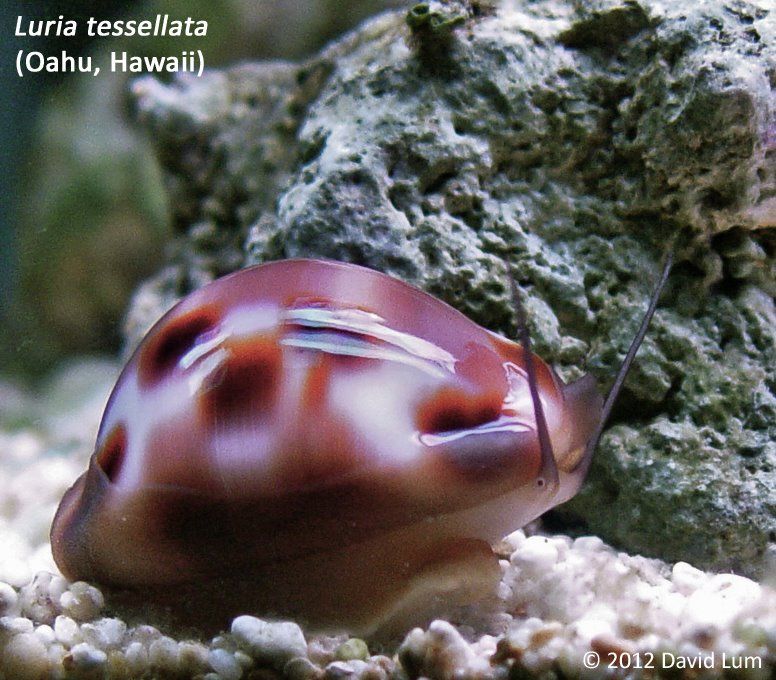
Photo Credit: David Lum
The Checkered Cowry, Luria tessellata, is endemic to Hawaii. Shells have a unique pattern; three or four large, dark, and squarish spots are found in a checkered pattern, with light tan and white bands across the back. In live Checkered Cowries, the mantle is transparent and the markings and spots on the shell can be seen clearly.
Growing to around 2 inches in length (5 cm), they are found hiding deep in crevices and far under ledges, and can occur in shallow water to depths of around 200 feet.
Half-Swimmer Cowry
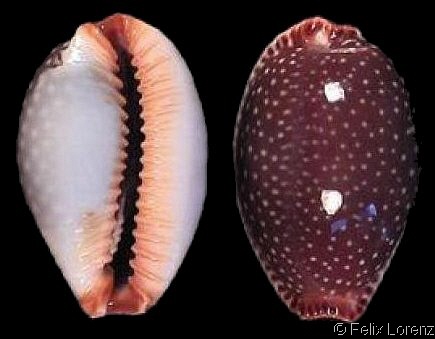
Photo Credit: Felix Lorenz
The Half-Swimmer Cowry, Staphylaea semiplota, is endemic to the Hawaiian Islands and was once very common, but the population crashed during the 1940s and 50s, and while it has received, hasn’t managed to regain former numbers. They are found in shallow water to depths of 130 feet.
Half-Swimmer Cowries reach around 1.5 inches in length, and they are called puleholeho in native Hawaiian which means “dusk” or “twilight”, referencing the coloration. The back of the shell can vary in coloration, from a grey white to a dark brown, and covered with tiny white dots, looking almost like a starry night sky. The base is white, while the grooves between the teeth are orange. Its mantle is black with many papillae, which can be mottled grey-white. They are often associated with a sponge of the same coloration as the mantle, which aids in camouflage, although they also feed on algae and can be successfully kept in a reef tank.
Humpback Cowry
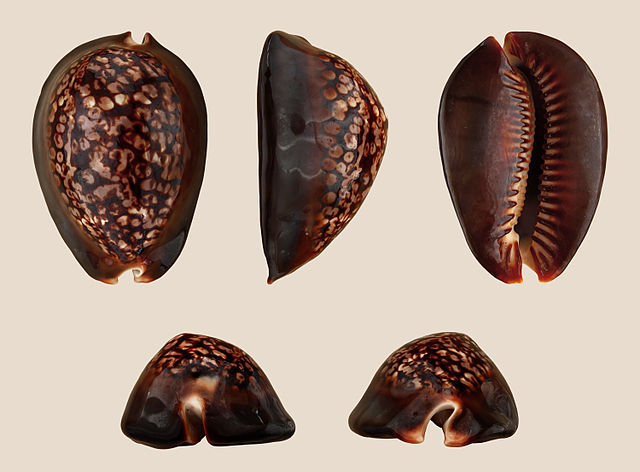
Photo Credit: H. Zell, CC BY-SA 3.0
The Humpback Cowry, Mauritia mauritiana, has a distribution across the Indo-Pacific region, and is found often in Hawaiian waters, even as high up as the intertidal zone, and especially in areas of strong wave action. It is quite a large species, reaching a maximum length of 5.1 inches (13 cm) and averaging 2.6-3.1 inches (6.5-8 cm).
The shell of the Humpback Cowry is entirely brownish black, even the underside, and dappled with irregular light markings. The shell is humped to almost a point, and the base of the shell is wide and thick; both of these characteristics combined enable the Humpback Cowry to withstand strong surf. The mantle of live Humpback Cowries is also dark brown or black, helping it to blend in with the dark rocks where it lives.
Featured Image Credit: Nhobgood Nick Hobgood, CC BY-SA 3.0