


Pictus Catfish Lifespan
History and Natural Habitat
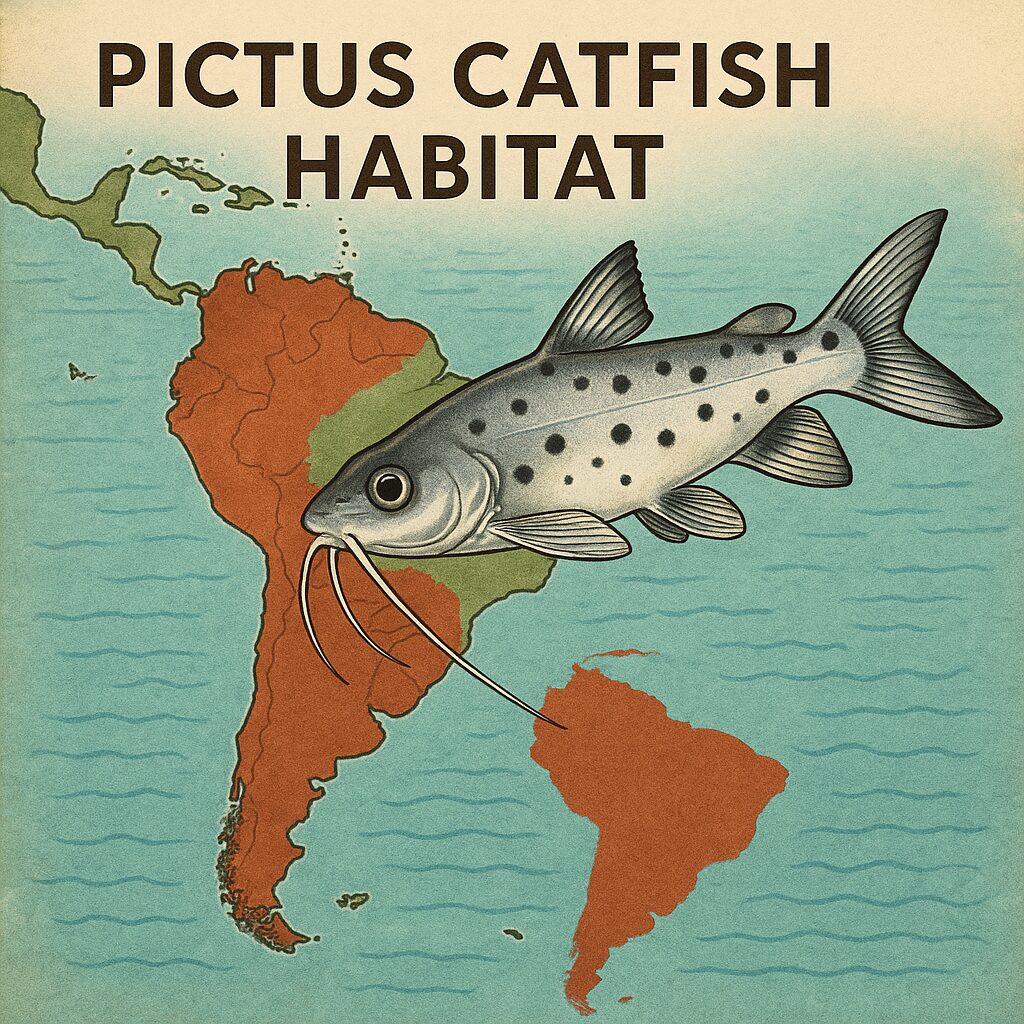 The Pictus Catfish originates from the dynamic freshwater systems of the Amazon and Orinoco basins, where water and sediment are in constant negotiation. Found throughout Colombia, Venezuela, Peru, and Brazil, these fish have adapted to rivers that never stay still—currents that carve new paths, reshape the land, and dictate the rhythms of life. In such environments, the Pictus seeks structure: tangled roots, fallen branches, or the shade beneath stones. These shelters offer protection and stability in a world defined by motion.
Their native waters are typically warm year-round, soft to moderately hard, and slightly acidic to neutral in pH. Continuous flow ensures high oxygen levels, while decaying plant matter enriches the ecosystem. During the rainy season, as floodwaters expand the boundaries of the river, Pictus Catfish move into the newly submerged forests, taking advantage of the surge in available food. This seasonal migration is not dramatic, but purposeful—an instinctive adjustment to the changing pulse of their environment.
In the wild, they are opportunistic omnivores and efficient scavengers. Their long, sensitive barbels serve as instruments of detection, allowing them to interpret chemical and tactile cues in murky water. They methodically search the substrate for small fish, insect larvae, crustaceans, and bits of organic debris. It’s a precise, almost methodical behavior—an evolutionary solution to life in low visibility. To study them is to see how adaptation becomes behavior, and how behavior, over time, becomes instinct written into the biology of a species.
Pictus Catfish Care
Pictus Catfish require attention to a series of key aspects, although they’re really moderate in terms of difficulty. They’re very hardy once established but possess very specific needs that must be fulfilled so that they can thrive.
Tank Size The smallest tank you can have for Pictus Catfish is 55 gallons for a single one, but 75 gallons or larger is recommended, especially if you plan on housing them in small groups. They swim quickly and are active, and they require a great deal of horizontal swimming area. One of the largest errors that people who are first-time fish owners make is that they misunderstand their space needs by their comparatively small adult size of 4 to 5 inches.
If you desire to keep multiple Pictus Catfish in the same tank, and they prefer that because they are fairly social creatures, you will have to supply at least 75 to 100 gallons for a trio or quad. Crowding will encourage greater aggression between them, poor growth, and ill health.
Water Parameters
Basically, the health of the Pictus Catfish greatly relies on stable water parameters. They do best in conditions very similar to what they experience in the Amazon. Numbers for the water parameters should show a temperature of 75-81°F, with an optimal range on the 77-79°F mark. The pH should be between 6.5-7.5 on the slightly acidic side, and the water hardness should be in the 5-15 dGH range.
These catfish are particularly sensitive to ammonia and nitrite, requiring pristine water conditions. The nitrate level should remain below 20 ppm with good, regular water changes. An Americial filtration is important since Pictus Catfish are moderate bioloaders that require well-oxygenated water with a gentle to moderate flow resembling their riverine habitat.
Regular water changes of 25 to 30 percent each week are good practice for water quality. Always remember to use dechlorinator when adding new water and that it matches the same temperature as the established aquarium so as not to shock your fish.
Live plants can also be introduced, though they’re not obligatory. Java Fern, Anubias, and Amazon Swords are good options as they’re hardy and won’t bother the catfish. Floating plants are also helpful in diffusing light, which these fish appreciate because they’re nocturnal.
One most important consideration is a close-fitting cover with no gaps. Pictus Catfish are notorious jumpers, especially when scared or on their active nighttime forays. Many aquarists have had fish jump out because of inadequate coverings on tanks.
Barbel erosion or injury can occur when the substrate is coarse or water is poor. Since barbels are a source of sensory perception for the fish, prevention through good water care and choice of substrate is crucial.
Finally, infections caused by parasites other than ich can infect Pictus Catfish, including gill flukes and skin parasites. Quarantining new fish for at least two weeks before introducing them to your community tank is the best disease prevention measure against introducing diseases.

Food & Diet
You can supplement their dry diets with protein sources like bloodworms that are frozen or alive, brine shrimp, daphnia, and blackworms. Not only are these a nutritious addition to their diets, but they also help to activate their hunting instincts. Fish and sea foods like shrimp cut into small pieces are also a delight for them.
Although Pictus Catfish are quite carnivorous, the addition of vegetables to their diets can be beneficial. Blanched zucchini squash, cucumber, spinach, and peas can be introduced occasionally to add fiber and nutrients to their diets.
Feed adult Pictus Catfish once or twice daily, offering only what they can consume within 5 minutes. Since they’re nocturnal, many aquarists find that feeding shortly after the lights go out yields the best results, though they will readily eat during the day once acclimated. Younger, growing fish may require more frequent feedings.
A point to note here is that Pictus catfish can consume small fish that can fit into their mouths. Although they are not aggressive hunters, their opportunistic behavior means that small tankmates may be considered prey, particularly during nighttime feeding frenzies.
Behavior & Temperament
One of the main reasons that Pictus Catfish can be so interesting to keep in an aquarium lies with their behavior patterns. Unlike some other examples of catfish that tend to lie dormant in caves for the entire day before becoming active at night, a Pictus Catfish remains fairly active during the daylight hours and becomes decidedly more so after the lights go out.
Such fish are quite peaceful and communal with other members of their species. In the wild, they are known to swim in a loosely formed group; of course, this behavior can be transferred to a tank environment. A lone Pictus Catfish may act quite shy and apprehensive, while a school of three or more members can display normal behavior that shows confidence. They communicate by body language and enjoy company from other members of their species.
Their swimming pattern can easily be recognized by bursts of speed followed by gliding. This species does not restrict itself to the bottom of the aquarium like those of the catfish family. This increases visibility and viewing pleasure.
Pictus catfish can cohabitate harmoniously with larger tankmates but should never be underestimated for their opportunistic behavior. This means that anything that can be termed as prey can be consumed by the pictus catfish since it’s opportunistic; it won’t go after prey actively but won’t miss a chance to eat either.
Startled, these fish can go into quite a panic and swim frantically around the tank at surprisingly fast rates of speed. This explains the importance of a tightly secured tank lid and the avoidance of rapid tankside movements. Rarely, the long barbels of this species may get snagged in netting; therefore, one needs to be extremely careful when netting them for capture. Often, aquarists choose to net them with a guiding container or two nets.
Pictus Catfish Tank Mates
Tankmates for Pictus catfish should be carefully matched for size, behavior, and activity level. Good choices include peaceful to semi-aggressive fish that are sufficiently large to not be preyed upon but small enough to not compete excessively with the catfish. You can use a fish compatibility checker to find suitable tank mates.
Great tankmates for your cichlid can be similar-sized South American cichlids such as Angelfish and Severums, Giant Danios, Rainbowfish, Larger tetras such as Congo tetras or Buenos Aires tetras, Gouramis (Pearl, Opaline, or Gold), Peaceful barbs such as Rosy or Tinfoil Barbs, Other non-territorial catfish species that are larger than your cichloids like Hoplo catfish or larger species of Corydoras catfish or Peaceful loaches. Fish that should be excluded include those that can fit into the mouth of the Pictus Catfish, which include Neon Tetras, Ember Tetras, Celestial Pearl Danios, Chili Rasboras, and small species of shrimp like Cherry Shrimp.
Those that are highly aggressive and can harass or hurt the catfish should not be included. This may include aggressive species of African Cichlids or aggressive specimens of Jack Dempsey Cichlids or Red Devil Cichlids. Slow-swimming fish with long fins like Guppies or Betta fish may be harassed by the active behavior of the Pictus Catfish.
Invertebrates like snails are generally safe with Pictus Catfish, as they’re too large and armored to be considered food. Large Mystery Snails, Nerite Snails, and Malaysian Trumpet Snails make good tank mates and help with algae control.
Carefully observe interactions when newly introducing tankmates to one another. Although Pictus catfish are known to be quite peaceful community tank fish, some may have unique personalities.
Breeding
A lack of sexual dimorphism between males and females also presents a challenge to breeding. Indeed, females may be slightly rounded when swollen with eggs, but this characteristic can hardly be noted. Thirdly, the fish may need specific environmental factors that are hard to create; for instance, changes in environmental water factors to resemble the rainfall season of their natural habitat. Fish also require a good amount of space to swim; hence, breeding can only be carried out in huge aquatic tanks.
In the wild, it was assumed that Pictus Catfish are egg scatterers that migrate to spawning grounds during floods. The eggs would then be scattered around plants and substrate and simply left to develop without any parental care. This would be extremely hard to recreate in a tank while still being able to provide the right water conditions.
For aquarists interested in breeding projects, there are many other catfish species that are far more likely to reproduce in home aquariums, such as Corydoras species or Bristlenose Plecos. If you do notice spawning behavior or eggs in your Pictus Catfish tank, immediately document the conditions and behaviors, as this information would be valuable to the aquarium hobby. Separate the eggs if possible to prevent them from being eaten, maintain pristine water conditions, and be prepared for potential fry that would require very small live foods such as infusoria or freshly hatched brine shrimp.


